Sponsored article
How to Care for Bolesławiec Pottery Used Every Day and Keep Its Patterns and Shine
- Which Everyday Habits Can Damage the Glazed Surface?
- How Should Coffee and Tea Stains Be Removed?
- How Should Greasy Food Residue Be Cleaned?
- Can Bolesławiec Pottery Be Washed in a Dishwasher?
- Is Bolesławiec Pottery Microwave-Safe?
- Why Is High-Temperature Firing Important?
- How Should Plates Be Dried and Stored?
- Do Water Marks Mean the Glaze Has Been Damaged?
- How Can Scratches and Chips Be Prevented?
- Why Does Proper Care Matter for Hand-Decorated Patterns?
- Everyday Use Does Not Have to Mean Faster Wear
- How to Keep Bolesławiec Pottery Looking Good for Years
- FAQ
- Can coffee and tea stains be removed without scrubbing?
- Can Bolesławiec pottery be washed in a dishwasher?
- Is Bolesławiec pottery microwave-safe?
- How can I tell the difference between mineral deposits and damaged glaze?
- Should plates be separated when stacked?
- Why do the patterns remain durable during regular washing?
Hand-decorated stoneware is designed to be used, not simply displayed. Cups, bowls and plates from Bolesławiec can become part of everyday breakfasts, dinners and coffee breaks while still retaining their characteristic colours and glossy finish for years.
Read more: The History of Ceramic Mugs – From Tradition to Modernity
Good care does not require complicated procedures. What matters most is avoiding repeated mechanical damage, sudden temperature changes and unnecessarily aggressive cleaning.
The decoration on Bolesławiec pottery is protected by glaze and high-temperature firing, which makes the finished surface suitable for regular kitchen use. Even so, sensible cleaning and storage habits can help preserve its appearance for longer.
Which Everyday Habits Can Damage the Glazed Surface?
The most common risks come from mechanical damage rather than from normal use itself.
Hard scouring pads, metal brushes and abrasive cleaning powders can scratch a glazed surface. Even when individual marks are initially difficult to see, repeated abrasive cleaning can gradually reduce the smooth, glossy appearance of the pottery.
For this reason, dried food should be softened with water rather than removed by intensive scrubbing.
Thermal shock is another factor worth avoiding.
Moving a very cold ceramic vessel directly into extremely hot conditions, or cooling a very hot piece rapidly with cold water, creates temperature differences within the material.
Bunzlau Manufaktura itself advises against sudden temperature shocks, for example pouring boiling liquid into a mug that has just been taken from the refrigerator.
Authentic boleslawiec polish pottery is fired at high temperatures and designed for everyday use, but durability does not mean that the material is completely immune to careless handling.
How Should Coffee and Tea Stains Be Removed?
Tea and coffee can gradually leave visible deposits inside frequently used mugs and cups.
Instead of using an abrasive cleaner, it is better to begin with soaking.
Bunzlau Manufaktura recommends gentle cleaning methods and specifically mentions baking soda or lemon juice for coffee stains.
A practical approach is to:
fill the vessel with warm water;
allow dried deposits to soften;
use a small amount of baking soda where necessary;
clean the surface with a soft sponge or cloth;
rinse thoroughly afterwards.
If a stain remains, the treatment can be repeated rather than immediately switching to a rough scourer.
The same principle applies to food residue on plates and bowls.
Soaking allows water and detergent to loosen the deposit before any mechanical force is applied.
How Should Greasy Food Residue Be Cleaned?
For ordinary grease, warm water and a standard mild dishwashing product are usually sufficient.
The glaze creates a smooth surface that is relatively easy to clean and does not need aggressive scrubbing under normal conditions.
It is especially useful to soak dishes when fat has dried onto the surface.
This reduces the temptation to scrape the glaze with a hard utensil or abrasive pad.
For mineral deposits or visible water marks, gentle acidic household solutions such as lemon juice may help, but the surface should always be rinsed well after cleaning.
The objective is to remove the deposit rather than polish the ceramic mechanically.
Can Bolesławiec Pottery Be Washed in a Dishwasher?
Yes. Bunzlau Manufaktura states that its cups, bowls and plates are suitable for dishwasher use.
The glazed surface protects the hand-applied decoration and makes routine cleaning easier.
At the same time, the manufacturer also recommends hand washing its mugs when the goal is to keep them looking their best for as long as possible.
Both statements can be true.
Dishwasher use is permitted, while hand washing provides more control over mechanical contact between individual pieces.
When loading the dishwasher, it is therefore sensible to make sure that:
plates do not knock against each other;
handles are not pressed against harder objects;
bowls are positioned securely;
delicate rims cannot move freely during the wash cycle.
For handmade ceramics, mechanical impact between dishes is often a more realistic risk than the washing process itself.
Is Bolesławiec Pottery Microwave-Safe?
Bunzlau Manufaktura describes its ceramic tableware as suitable for microwave use.
This means that everyday dishes can be reheated without transferring food to another container.
However, microwave safety should not be confused with complete resistance to every possible temperature change.
The same basic thermal-shock rule still applies: avoid sudden transitions between very cold and very hot conditions.
If a dish has just been stored in the refrigerator, allowing it to adjust slightly before exposing it to much higher temperatures is a cautious everyday habit.
Why Is High-Temperature Firing Important?
The durability of Bolesławiec pottery is closely connected with its production process.
Bunzlau Manufaktura describes an initial firing at approximately 900°C.
After decoration and glazing, the pottery undergoes another firing at around 1250°C.
This second high-temperature firing gives the ceramic its characteristic glossy finish and helps protect the decoration beneath the glaze.
The pattern is therefore not simply a surface print that can easily be wiped away.
It becomes part of the finished glazed product.
This is one of the reasons why properly cared-for Bolesławiec stoneware can be used regularly without quickly losing its decorative character.
How Should Plates Be Dried and Stored?
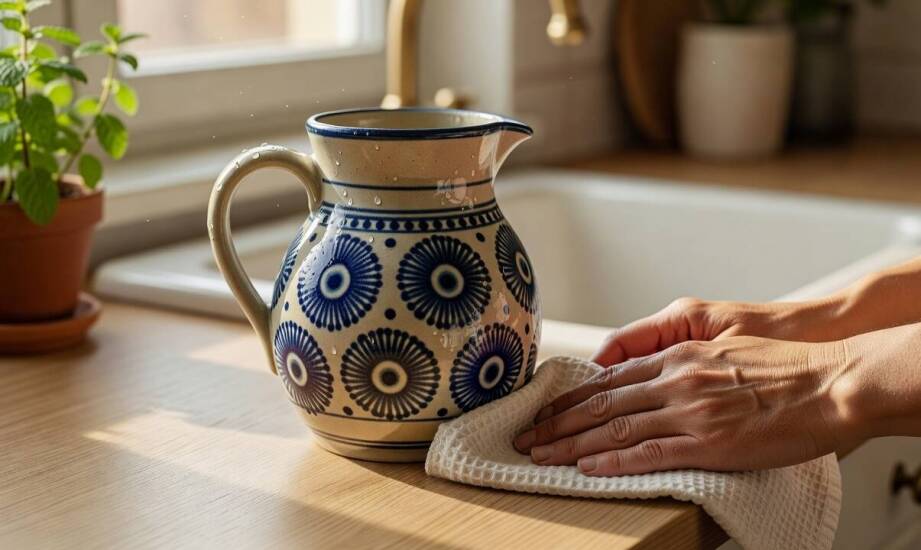
After washing, ceramic dishes can be allowed to air-dry on a stable rack or dried with a soft cloth.
The main objective during storage is to prevent unnecessary impact and abrasion.
Plates are naturally designed to be stacked, but very tall or unstable stacks increase the risk of accidental knocks.
If a collection is valuable or used less frequently, soft separators can be placed between particularly decorative pieces.
This can be useful for dinner plates as well as smaller breakfast plates, especially when different shapes are stored together.
Cups, teapots and vessels with projecting handles or spouts deserve slightly more space.
These elements are more vulnerable to impact than broad glazed surfaces.
Do Water Marks Mean the Glaze Has Been Damaged?
Not necessarily.
A dull-looking area can sometimes be caused by mineral residue left behind after water evaporates.
This is different from a permanent scratch or chip.
Before assuming that the glaze has become damaged, the piece should first be cleaned gently and thoroughly.
A removable deposit will disappear after cleaning, while genuine mechanical damage normally remains visible or can be felt under the fingers.
Signs of real physical damage include:
a chip on the rim;
a deep scratch;
a crack;
a rough area where the glaze has been lost.
Surface deposits and permanent damage should therefore not be treated in the same way.
How Can Scratches and Chips Be Prevented?
The simplest rule is to reduce hard contact between ceramic pieces.
Most everyday damage occurs when tableware:
hits another plate in the sink;
is dropped into a dishwasher basket;
is stacked too aggressively;
knocks against metal utensils or cookware.
Handmade stoneware may be durable, but ceramic materials remain vulnerable to impact.
Taking a few seconds to place pieces carefully in the sink, dishwasher or cupboard can therefore make a larger difference than using specialised cleaning products.
Why Does Proper Care Matter for Hand-Decorated Patterns?
Bolesławiec pottery combines function with visible craftsmanship.
Even within the same pattern, individual pieces may show slight differences because the decoration is applied by hand.
This means that a frequently used mug or plate can gradually become a familiar, individual object rather than simply one replaceable part of a mass-produced set.
Proper care helps preserve both the glaze and the visual clarity of the pattern underneath it.
Because the decoration is protected by the glazed finish, normal washing does not require special preservation treatments.
What matters is avoiding unnecessary abrasion and impact.
Everyday Use Does Not Have to Mean Faster Wear
Good-quality stoneware does not need to be reserved for special occasions.
Bunzlau Manufaktura explicitly produces its plates, cups and bowls for everyday use and describes them as suitable for modern kitchens.
The best care routine is therefore simple:
wash normally;
use soft cleaning accessories;
soak stubborn deposits instead of scraping them;
avoid sudden temperature shocks;
prevent pieces from knocking together;
store them securely.
These habits allow traditional handmade pottery to function as real household tableware rather than as decoration kept behind glass.
How to Keep Bolesławiec Pottery Looking Good for Years
Maintaining the shine and patterns of Bolesławiec ceramics is mainly about preventing avoidable damage.
The high-temperature firing and glaze already provide the foundation for regular use.
Daily care should simply support those properties.
Gentle cleaning protects the surface.
Careful loading prevents chips.
Avoiding thermal shock reduces unnecessary stress on the material.
Proper storage limits scratching and accidental impact.
The goal is not to treat Bolesławiec pottery as fragile museum ware, but to use it normally while respecting the characteristics of handmade glazed stoneware.
With sensible care, cups, bowls and plates can remain functional and visually attractive through years of regular breakfasts, dinners and family gatherings.
Avoid abrasive scourers and aggressive mechanical scrubbing.
Soak dried food and beverage deposits before cleaning.
Baking soda or lemon juice can help with stubborn coffee stains.
Bunzlau Manufaktura pottery is dishwasher- and microwave-safe.
Hand washing provides additional control and reduces the risk of pieces knocking together.
Avoid sudden temperature changes between very cold and very hot conditions.
Store plates and other tableware securely to reduce scratches and chips.
A dull deposit does not automatically mean permanent glaze damage.
FAQ
Can coffee and tea stains be removed without scrubbing?
Yes. Start by soaking the vessel in warm water. Baking soda can be used for stubborn coffee deposits, and Bunzlau Manufaktura also recommends lemon juice as a gentle cleaning option. Use a soft sponge or cloth instead of abrasive pads.
Can Bolesławiec pottery be washed in a dishwasher?
Yes. Bunzlau Manufaktura states that its tableware is dishwasher-safe. Careful loading is still important because plates, cups and bowls can chip if they repeatedly knock against one another.
Is Bolesławiec pottery microwave-safe?
Yes. The manufacturer describes its ceramic tableware as suitable for microwave use. Sudden temperature shocks should nevertheless be avoided.
How can I tell the difference between mineral deposits and damaged glaze?
Deposits usually disappear after gentle cleaning. A permanent chip, crack or deep scratch remains visible or can be felt when you run a finger carefully across the surface.
Should plates be separated when stacked?
It is not necessary for every everyday stack, but separators can be useful for valuable pieces, long-term storage or mixed stacks where decorative surfaces and rims may rub against one another.
Why do the patterns remain durable during regular washing?
The pieces are decorated, glazed and then fired at high temperature. The glaze protects the decoration and creates the smooth finished surface used in everyday tableware.
You might be interested

How the diversity of vegetable offerings affects the competitive advantage of stores
Why Does Automatic Deburring Produce Different Results on the Same Sheet Metal?

Why choose Pharmaquinone as your vitamin K2 supplier for supplement production?